Category: News (Older posts)

  • COGCC wildlife series rulemaking new substantial protections effective January 15, 2021

    The new wildlife series rules referenced below became effective on January 15, 2021.

    Earlier post on November 23, 2020:

    On November 23, 2020 the Colorado Oil and Gas Conservation Commission voted unanimously to adopt new wildlife rules [1200 series] that provide substantially improved protections for wildlife.  We thank the Commission, staff and Colorado Parks and Wildlife (CPW) for their excellent painstaking work during this momentous rulemaking. We also thank the general assembly and Governor Polis for the 2019 law [SB 181] that requires protection for public health, safety, welfare, the environment and wildlife resources and required this rulemaking.

    Mule deer, elk, bighorn sheep and pronghorn:

    An operator must enter into a CPW-approved wildlife mitigation plan if proposing more than 1 location within 1 square mile in severe winter range and migratory corridors.  1202 d. For bighorn sheep, the new rule is no surface occupancy in bighorn sheep production areas. 1202 c.

    Wildlife maps for these high priority habitats will be updated annually and subjected to a hearing. This will be especially important as migratory corridors, pinch points and stopovers where applicable, are updated.

    At times CPW  and Bureau of Land Management will disagree on high priority habitats and their application under the new rules. CPW may recommend greater protections and the Commission will make the decision where there is a disagreement.

    Gold Medal Waters:  The new rules require a 500 feet buffer [no surface occupancy] with the exception that a location can be sited closer only if Commission grants a variance after a public hearing. An operator must consult with CPW before applying for a variance.

    Cutthroat Trout Habitat and Native Species Conservation waters:  Under the new rules a 500 feet buffer [no surface occupancy] is required, subject to these exceptions:

    An operator can locate 300-500 feet if (a) CPW waives and COGCC Director supports, and (b) application incorporate the spill-prevention measures (Rule 411) with possible exception of the requirement of daily inspections. An operator cannot locate a wellpad and associated infrastructure  from 0-300 feet buffer only if Commission grants a variance after a public hearing

    Sportfish Management Waters:  A 500 feet buffer [no surface occupancy] is required, except an operator can locate between 300-500 feet if (a) CPW waives and COGCC Director supports, and (b) application incorporates the spill-prevention measures from Rule 411 (with possible exception of the requirement of daily inspections). An operator may locate 0-300 feet from intermittent or ephemeral streams if CPW waives and COGCC Director supports, and 0-300 feet from perennial waters only if Commission grants a variance after a public hearing.

    Compensatory Mitigation fee

    An operator will pay a flat fee  for disturbances up to 11 acres IF the Commission decides to approve a permit in which the operator cannot avoid or minimize adverse impacts to wildlife.  The Commission will review the fee amount on a regular basis.

    Earlier during the proceedings:

    The Colorado Oil and Gas Conservation Commission wildlife series (1200 series) rulemaking hearing opened on November 10 with oral public comment.  The comments ran 2:1 in favor of the revised draft rules/strengthening the draft rules  v. worries that the draft rules would harm the oil and gas industry.  CWF is a party to the rulemaking, represented by Bob Randall, former Executive Director of Department of Natural Resources.

    On November 23 the Commission will conclude their deliberations and vote. CWF will post highlights of the new rules then. The Colorado Oil and Gas Conservation Commission voted unanimously on October 13 to delay the wildlife series rulemaking hearings that were scheduled to begin on the 13th.  The hearing now are scheduled to begin on November 10, resume on the 12th-14th and extend in to the following week.  The reason for the delay was that COGCC issued revisions to the draft wildlife rules on Friday, October 9, which was insufficient to meet the requirement of the Administrative Procedures Act that mandates issuance at least  5 days in advance of the hearing.advance

    COGCC tentatively approved revisions to Rules series 200-600 on September 28, 2020.  Written public comment on the wildlife series was reopened until October 8 November 4 at  5pm.

    SB 181 which mandated the rulemaking œensures that oil and gas development and operations in Colorado are regulated in a manner that protects public health, safety, welfare, the environment and wildlife resources.

    CWF’s positions on wildlife 1200 series:

    CWF agrees with the COGCC draft rules (and now the revised draft rules)  in large part.  As to protections for High Priority Habitats of bighorn sheep, mule deer, elk and pronghorn, however, we believe the draft protections need to strengthened based upon the current science that has evolved.  We urge:

    — surface disturbance from oil and gas development in bighorn sheep migration corridors, production areas, severe winter range and winter concentration areas not exceed 3 % of a section (square mile). The revised draft changed from the draft rule for bighorn sheep production areas.  It now provides no ground disturbance in sheep production areas. Very good!

    — surface disturbance from oil and gas development in mule deer and elk  migration corridors, production areas, severe winter range and winter concentration areas not exceed 3% of a section (square mile).

    –surface disturbance from oil and gas development in pronghorn migration areas, severe winter range and winter concentration areas not exceed 3% of a section (square mile).

    As to aquatic areas:

    –Wetlands and streams should be designated as High Priority Habitats and buffered by 500 feet. The revised draft issued on October 9 has changed from the draft. The draft provided a 300 feet buffer and the revised draft specifies a 500 feet buffer.  Great news!

    –Gold Medal waters designated by Colorado Parks and Wildlife and native cutthroat trout streams should be protected by a buffer of 1,320 feet (1/4 mile).   The revised draft provides a 500 feet buffer.
     

  • It’s CO Backcountry Winter Safety Awareness Week

    The Governor proclaimed the week of December 7-13 as Colorado Backcountry Winter Safety Awareness Week. To reduce any increased impact on Colorado’s natural resources and search and rescue teams Colorado Parks and Wildlife, Colorado Tourism Office, Office of Outdoor Recreation Industry, Colorado Avalanche Information Center and Colorado Search and Rescue Association developed a backcountry safety pledge.  Take the Pledge

    Also see CareForColorado which contains 7 Care for Colorado Principles, Care for Colorado video, Trash the Trash, and other education resources.


  • CO Gov. Polis Exec Order creating CO Regional Partnerships Initiative

    On October 30, 2020 Gov. Polis issued an Executive Order that creates Regional Partnerships.  This Executive Order was issued during the event opening Fishers Peak State Park in Trinidad.  CWF views formation and operation of the regional partnerships as a very important endeavor. Below is the Executive Order and here are the stated goals:

    1. Ensure that Colorado’s lands, waters and wildlife thrive in the face of climate change and other threats while also providing for equitable and safe access and quality outdoor recreation experiences for all Coloradans;

    2. Establish a state-level vision for conservation and recreation and convene voices from different outdoor interests, races, cultures, ages, and sectors through regional partnerships to inform the development of a shared strategy and statewide action plan;

    3. Identify additional stable and long-term funding from multiple, sustainable sources to provide for the critical investments needed to conserve Colorado’s landscapes, rivers, wildlife, sensitive habitats and recreational opportunities.

    In the Executive Order the task to create the statewide vision referenced above is assigned to Department of Natural Resources, Colorado Parks and Wildlife and the Colorado Outdoor Partnership, in which CWF serves.

    Executive Order

  • President signs America’s Conservation Enhancement Act

    On October 30, 2020 the President signed into law the America’s Conservation Enhancement Act   (S. 3051). CWF is pleased! Specific provisions include:

    establishing a chronic wasting disease (CWD) task force to develop an interstate action plan for state and federal cooperation relating to the disease, and commission a study by the National Academy of Sciences as to pathways and mechanisms of CWD  transmission;

    reauthorizing the North American Wetlands Conservation Act until 2025;

    encouraging partnerships among public agencies and other interested parties for promoting fish conservation;

    reauthorizing the National Fish and Wildlife Foundation Act until 2025


  • New Colorado State Park: Fisher’s Peak Opens October 30

    Governor Polis opened our newest and second largest State Park, Fishers Peak State Park, on Friday, October 30, 2020.  He spoke of goals of public access, contributing to the local economy  and protection of this land. At the outset, a small area – 250 acres will be opened to the public with a 3/4 mile trail, picnic area and of  course, the marvelous views. Fishers Peak encompasses more than 55 square miles. After this grand opening, the Park will be open from sunrise til sunset daily.  Please practice social distancing when you visit!

    During the opening event, the President of Trinidad State Junior College, Dr. Rhonda Epper, spoke of how the College will introduce students to the Park, trail building, and biology and its natural resources.  She said, “My dream for our students and for Trinidad is for the entire state to discover and experience this treasure that we have known for generations… Our local kids know this land-the mountains, fields, and plains that surround Fishers Peak. They have grown up hunting, fishing, playing, and observing the wildlife of this area. But many haven’t had opportunities to explore it educationally or connect their knowledge to a potential career path. This Park has the potential to inspire a new generation of scientists, conservationists, trail builders, land technicians, and outdoor enthusiasts from our local community.”

    At the event CWF’s Suzanne O’Neill spoke with  Rafael Jimenez of Pueblo, who serves as a volunteer for Colorado Parks and Wildlife. He helped to build the Challenge trail from an old road. He is justifiably proud of this important work as it opens to the public to experience and enjoy.

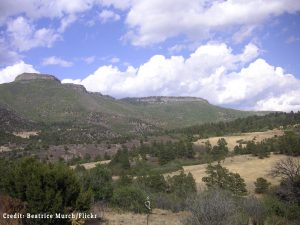
    Earlier: On June 30, 2020, Fishers Peak officially became Colorado’s newest state park.  Its 19,200-acres, located a few miles outside of Trinidad, is the 42nd state park.  The video of Governor Polis signing  into law SB 3 can be viewed on the Governor’s website. This special space has abundant wildlife and amazing outdoor recreation opportunities. In these difficult times official designation of this spectacular park is uplifting for the local community, all Coloradans who seek more outdoor recreation options, wildlife enthusiasts and other conservationists.

    On May 14, Colorado Parks and Wildlife had announced that its acquisition was completed. There will be several phases of development and a substantial area will remain undeveloped important wildlife habitat for mule deer, bears, and mountain lions.


  • Congress Passes Bipartisan ACE Act

    On October 1, 2020 the House passed the bi-partisan America’s Conservation Enhancement Act (ACE) on a voice vote, joining with the Senate’s earlier passage of this important conservation bill.

    Here are key provisions:

    Establishing a chronic wasting disease task force to develop an interstate action plan for state and federal cooperation relating to the disease;

    Commissioning a study by the National Academy of Sciences regarding the pathways and mechanisms of the transmission of chronic wasting disease in the US;

    Reauthorizing the North American Wetlands Conservation Act until 2025;

    Encouraging partnerships among public agencies and other interested parties for promoting fish conservation;

    Reauthorizing the Chesapeake Bay Program until 2025 and reauthorizing the Chesapeake Bay Gateways and Watertrails Network and the Chesapeake Bay Gateways Grants Assistance Program until 2025;

    Reauthorizing the National Fish and Wildlife Foundation Act until 2025;

    Establishing a program to provide grants to states and Indian tribes to compensate livestock producers for losses due to predation by federally protected species such as wolves or grizzly bears; and

    Establishing a Theodore Roosevelt Genius Prize for technological innovation to reduce human-predator conflict using non-lethal means.


  • CWF honors Kent Ingram, former Board Chair who passed away August 28

    CWF honors our former chair of the board of directors, Kent Ingram, who passed away on August 28, 2020. Kent was a conservation force in Colorado and will be greatly missed.

    Board Chair Robin Knox’s message to the CWF Board, morning of August 29

     œIt is with regret and sadness that I have to tell you that Kent Ingram passed away yesterday morning from melanoma cancer.  Kent worked tirelessly for decades to represent the concerns, opinions, and beliefs of Colorado hunters, anglers and conservationists whenever and wherever he could to try to affect common sense and wise use ideals into policy and regulation decisions. He loved to hunt and fish as we all know. He has left a large set of shoes to be filled by those of us on the CWF board. Kent remained positive about his situation, and involved with CWF, until the past two weeks, when his illness made it impossible.  His strength and determination should be an inspiration to us all.

    The quotes of August 28 

    Message Walt sent to the Issues Committee–

    œIt is with great sadness that I must report that our good friend Kent Ingram passed away this morning. You may or may not know that he has been courageously fighting melanoma these last several months. In characteristic fashion he kept his positive attitude in this fight to the very end. To say that he will be missed is a gross understatement. He was a champion of the average sportsman and conservationists. His energy and devotion to both wildlife and sportsmen via the Colorado Wildlife Federation for many, many, many years has been a foundation of this organization. He leaves a huge hole in the conservation world. He also leaves a huge hole in me as a close friend and I suspect the same is the case with many of you.
    R.I.P. my friend. 

    John Smeltzer, Former Board Chair CWF–

    œAnother good friend and “giver” of himself to “All Things Wild” in Colorado has passed …. and all too soon

    ….. Kent Ingram, former Chairman of the Board of Colorado Wildlife Federation and a long-time board member lost his health battle this week amidst the arms of his family, of that I have little doubt. Kent was a doer …. on Not-For-Profit Boards you need doers …. and he was definitely in that category big time.  You might not agreed with all that he said and did ….. but the more you knew him the more you knew he had thought through a set of elements that were his guideposts regarding his passion for the “average” angler / hunter or wildlife enthusiast and he “knew” what he had to do.  He had to support them ….. And for at least 17 years he contributed directly to that cause with Colorado Wildlife Federation. We have all lost a little with his passing.

    Kent was real, he was unique and he was genuine …..
    There is a contemporary song by Thomas Rhett et al that kept playing today on the radio as I mull over Kent’s passing and I think it’s appropriate to say that I strongly believe he fit the message of the song so very well… “In a World Full of Hate Be a Light” …..
    Rest in Peace Kent …. it’s time to rest …. you done good my friend, you done good. 


    Bob Meulengracht, Vice Chair CWF Board, and his wife Krista — 

    œWe have lost a great friend, sportsman and wildlife advocate.  Our thoughts and prayers are with Kent, his family and friends.  God speed, Kent! 


    Brian Kurzel, Regional Executive Director, National Wildlife Federation–

    œI just heard the tragic news and wanted to reach out immediately to express my deepest sympathies for Kent’s passing this morning. Please pass our condolences on to Kent’s family and the whole CWF Board. This is a loss for so many, not least of which is all who value Colorado’s wildlife and natural values. Kent’s influence as an advocate and voice forwildlife is almost unparalleled during his tenure as CWF’s Board Chair, and his fingerprints are on many policies and actions that have made Colorado a better place for wildlife and for people. 

    I worked with Kent for the better part of a decade, first when I was helping manage hunting and fishing regulations with CPW, then in our work with the Federation. I can honestly say that Kent’s steady, but firm and well-informed advocacy helped to inspire me personally to move from government to advocacy, as I saw what a true advocate looked like. I will miss Kent, and commit to honoring his legacy by protecting wildlife in Colorado, and I will always strive to follow Kent’s example of what it means to be a good, honest person in this world. œ  


     John Gale, Backcountry Hunters and Anglers Conservation Director — 

    œHow very sad to lose such a lion at such a young age. I know he’s roaring in the happy hunting grounds but his spirt in this world is already a great loss. 


    Lee Carlson, CWF Issues Committee, Former US Fish and Wildlife Service — 

    I’m saddened to hear of Kent’s passing. He will be sorely missed.   


    Bob Goodnough, CWF former Board member and Issues Committee member–

    œI will never forget all the great times we had hunting and fishing in Gunnison and Flaming Gorge. He was a true sportsman, always did things the right way. He will be greatly missed. 


    Harvey Nyberg, Former CWF board members and Issues Committee member

    œKent is a giant of conservation and of Colorado Wildlife Federation and a good friend. After he retired, he enjoyed few things as much as the time he spent with his grandkids. He evenfound time for an occasional trip. I’m so sorry his retirement was shortened by this disease.My thoughts go out to his family and friends. 


    Dennis Buechler, former CWF Board Chair and current Issues Committee member 


    œI helped getting him on the CWF Board, and we have been good friends since then.

    I truly appreciated the leadership he gave while serving as president of the CWF Board for many years. You will not find a more dedicated conservationist. He will be missed by many organizations and conservation leaders. I salute him and his family. 


     Joshua Torrez, CWF Board member–

    œOmg this breaks my heart. 


     Aaron Kindle, NWF Sportsman’s Advocate 

    œOh my gosh. I am so sorry. Rest in Peace Kent. œ 


     Lew Carpenter, NWF Director of Conservation Partnerships– 

    œI’m heartbroken. He was a good friend and incredible advocate. We hunted many times together. 


    Brent Miller, CWF Board member — 

    œI am so sad to hear that. He will be greatly missed. 


    Dennis and Lisa Buechler

    All of us anglers, hunters and environmentalists who ever worked with and/or enjoyed the outdoors with Kent held him in the highest respect. He had so many good friends and comrades. His strong advocacy for ethical sporting and fair play made him our contemporary Aldo Leopold.  He sometimes called me his (conservation hero) which I found very humbling coming from him. The feeling was certainly mutual. The amount of effort and devotion that he gave CWF and many other organizations certainly places him among Colorado’s all-time best conservation leaders. We all will miss him.


     Larry Strohl, CWF Issues Committee member, former Colorado Parks and Wildlife —

     œI can recall many, many discussions over the years over the issues of the day. He usually would listen to input, but rarely changed his opinions. To say he will be missed is an understatement.

    In a true sense, he is irreplaceable. I only hunted turkeys with him but enjoyed every trip, even to Kansas. Blessing to Linda and the family. God speed. 


     Jeff VerSteeg, Colorado Parks and Wildlife – 

    œI’m shocked and saddened. Thank you so much for sharing this sad news. 


     Nick Payne, Theodore Roosevelt Conservation Partnership

     œThis is terrible. My condolences to the family. He will be greatly missed and as you said has been such a pillar in all of our worlds for so long.  Tearing up here¦. 

  • President signs bipartisan Great American Outdoors Act


    On August 4 the President signed the Great American Outdoors Act.  This Act had passed the House and Senate on a huge bi-partisan vote. [The House passed the Act on a  bipartisan vote of 310-107.  The Senate passed the bill 73-25 on June 17.]

    It  fully and permanently fund the Land and Water Conservation Fund at $900 million and address deferred maintenance backlogs at national parks and other public lands. What a win for wildlife, public lands, community parks and trails.  The public demand for outdoor spaces is evident from the  robust use of Colorado’s parks and trails this year. Many organizations including CWF have worked a long time to gain full and permanent funding for the Land and Water Conservation Fund.  Over the years, LWCF has contributed more than $268 million for Colorado’s public lands, trails and community parks.

    It will create jobs in these difficult times and boost the outdoor recreation economy.  Senator Gardner sponsored this legislation and has worked tirelessly on it for a long time. Senator Bennet is among the co-sponsors.  We thank them both.

  • District Court judge rules in favor of greater sage grouse protection

    On Friday, May 22, 2020, federal district court judge in Montana ruled in favor of greater sage grouse protections and against the BLM and its resource management plans’ amendments. Montana Wildlife Federation et.al. v. Bernhardt et.al. (CV-18-69-GF-BMM May 22, 2020).   It set aside the lease sales that were offered in priority grouse habitat in violation of the Federal Land Policy and Management Act. BLM had instead followed its 2018 Instruction Memorandum (IM 2018-026) that it claimed enabled it to disregard the 2015 plans that had required leasing be prioritized outside of grouse priority habitat.

    The lawsuit concerned lease sales in Montana, Wyoming and Nevada.  It is a tremendous victory as grouse habitats continue to dwindle with development and fragmentation.

    The 2015 plan in Colorado and plans in other western states were a product of broad, diverse collaboration with the aim to prevent listing of the greater sage grouse as a threatened or endangered species.  In Colorado, too, although not directly at issue in the lawsuit, BLM has disregarded its 2015 resource management plan requirement that it prioritize areas outside of priority sage grouse habitat to offer at quarterly oil and gas lease sales.  In North Park, priority grouse habitat has been heavily leased.  Instead BLM relied upon the above Instruction Memorandum which the judge in the case held violated the Federal Land Policy and Management Act.  The BLM should stop relying upon its IM and immediately halt leasing in priority grouse habitat in Colorado as well.

  • District Court judge rules in favor of greater sage grouse protection

    On Friday, May 22, 2020, federal district court judge in Montana ruled in favor of greater sage grouse protections and against the BLM and its resource management plans’ amendments. Montana Wildlife Federation et.al. v. Bernhardt et.al. (CV-18-69-GF-BMM May 22, 2020).   It set aside the lease sales that were offered in priority grouse habitat in violation of the Federal Land Policy and Management Act. BLM had instead followed its 2018 Instruction Memorandum (IM 2018-026) that it claimed enabled it to disregard the 2015 plans that had required leasing be prioritized outside of grouse priority habitat.

    The lawsuit concerned lease sales in Montana, Wyoming and Nevada.  It is a tremendous victory as grouse habitats continue to dwindle with development and fragmentation.

    The 2015 plan in Colorado and plans in other western states were a product of broad, diverse collaboration with the aim to prevent listing of the greater sage grouse as a threatened or endangered species.  In Colorado, too, although not directly at issue in the lawsuit, BLM has disregarded its 2015 resource management plan requirement that it prioritize areas outside of priority sage grouse habitat to offer at quarterly oil and gas lease sales.  In North Park, priority grouse habitat has been heavily leased.  Instead BLM relied upon the above Instruction Memorandum which the judge in the case held violated the Federal Land Policy and Management Act.  The BLM should stop relying upon its IM and immediately halt leasing in priority grouse habitat in Colorado as well.