Tag: News

  • CO Dept Public Health & Env. Issues Rules as good first step to better protect Colorado’s waters

    CO Dept Public Health & Env. Issues Rules as good first step to better protect Colorado’s waters

    CWF has been a party to the Colorado Department of Public Health and Environment rulemaking pursuant to the law passed in 2024. We are pleased with this first step to better protect Colorado’s waters due to the ruling last week. CWF also participates in a coalition of 26 wildlife-related and other conservation organizations, CO Protect Our Waters Campaign. Below is the coalition’s press release:

    Colorado Steps Up to Protect Wetlands and Streams

    DENVER —The Protect Colorado Waters Coalition is pleased Colorado took significant steps to protect vitally important wetlands and streams in the state that were under threat of unregulated development after federal rollbacks.

    The Water Quality Control Commission (WQCC) on Wednesday evening issued rules setting the requirements for a dredge and fill permitting system that ensures most Colorado waters, including wetlands, can’t be destroyed without going through a state environmental review process.

    By adopting these rules, Colorado became the first state in the nation to develop a state permitting program after the Supreme Court limited the scope of the Clean Water Act.

    The coalition appreciates the WQCC’s work setting up a comprehensive dredge and fill program for Colorado’s waters. 

    The coalition helped secure key provisions concerning the scope of waters that are protected, compensatory mitigation, and language regarding ditches and alternatives. The rules also streamline the permitting process and provide important clarity for project proponents. 

    These rules are even more critical given efforts to continue rolling back federal protections. Just last month, the federal government proposed further limiting the Clean Water Act such that it would no longer protect 97% of Colorado’s remaining wetlands and 68% of the state’s stream miles. 

    This would not have been possible without the unwavering commitment of Speaker Julie McCluskie, Representative Karen McCormick, and Senator Dylan Roberts toward passing HB24-1379.

    While the rules are not everything the coalition sought, this is an important first step for Colorado’s environment and economy. Because of the hard work of the state legislature, the Colorado Department of Public Health and Environment and the Commission, Colorado’s waters are better protected.  


    The Protect Colorado Waters Coalition is made up of 26 organizations, working on freshwater conservation and representing more than 200,000 Coloradans. The coalition collaborated with the Colorado General Assembly in 2024 to enact strong bipartisan protections for Colorado waters and wetlands after a significant2023 U.S. Supreme Court decision weakened decades of federal clean water protections. This was the most substantial erosion of provisions of the Clean Water Act since it was enacted in 1972.
  • CPW completes its work on the 2025 State Wildlife Action Plan

    CPW completes its work on the 2025 State Wildlife Action Plan

    Colorado Parks and Wildlife has completed its work on the 2025 State Wildlife Action Plan and has submitted the Plan to the US Fish and Wildlife Service, as required. The purpose of the Plan is to guide conservation actions for species of greatest conservation need and to identify species of greatest information need. The Plan updates the 2015 version. CWF provided public comment as the plan was developed. The dashboard is comprehensive, providing information on each species in Colorado.  See https://cpw.state.co.us/state-wildlife-action-plan

    The Plan is a key plan under the umbrella of the Colorado’s Outdoors Strategy guidance document. See https://cpw.state.co.us/coloradosoutdoorsstrategy

    Implementation of the Plan is necessary to conserve Colorado’s wonderful biodiversity. CWF is evaluating the role we will undertake in this process. 

  • Colorado’s Outdoors Strategy has been launched!

    Colorado’s Outdoors Strategy has been launched!

    On April 23, 2025 Governor Polis and coordinating partners launched the Colorado’s Outdoors Strategy. The press release is below. Colorado’s Outdoors Strategy is the overarching strategy – not a plan – for Colorado’s goals of climate resilient conservation and outdoor recreation. CWF participated on the steering committee as the vision and strategy were developed. In our view, COS provides navigational guidance and robust tools to integrate wildlife conservation needs and outdoor recreation desires.T he tools are extremely helpful and are found on Colorado Natural Heritage Program’s CODEX (Colorado’s Conservation Data Explorer).

    Here s the link to the extensive press release and documents. https://www.colorado.gov/governor/news/states-outdoor-recreation-and-conservation-leaders-announce-launch-colorados-outdoors-strategy

  • Annual Conservation in the West Poll

    Annual Conservation in the West Poll

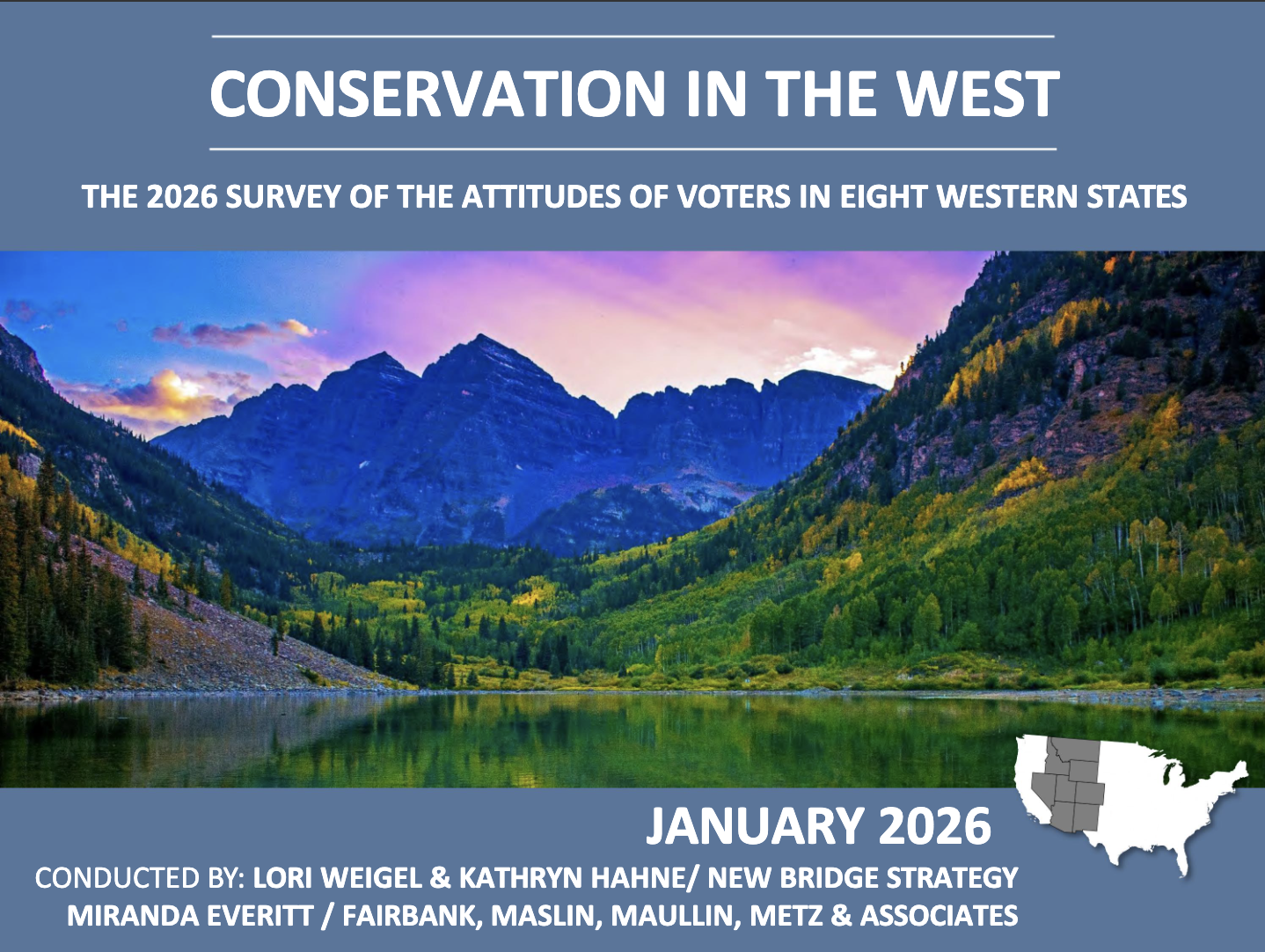
    On February 19, 2025 the annual Conservation in the West Poll was published. The Poll was conducted January 3-17, prior to the Inauguration. The Poll was conducted again this year by Lori Weigel and Kathryn Hayne of New Bridge Strategy and Dave Metz of Fairbank, Maslin, Maullin, Metz & Associates. They surveyed 3,316 voters in eight western states: Colorado, New Mexico, Utah, Arizona, Wyoming, Montana, Nevada and Idaho.  Here are a few Colorado highlights: 57% “believe that loss of habitat for fish and wildlife is an extremely or very serious problem.” 63% “oppose reducing protections for some of the rare plants and animals protected under the Endangered Species Act.” 88% prefer decisions about public lands, water, and wildlife be made by career professionals such as rangers, scientists, and firefighters rather than new appointed officials who come from other industries.” 70% “support only allowing oil and gas companies the right to drill in areas where there is high likelihood to actually produce oil and gas.” 76% prefer that leaders place more emphasis on protecting water, air, wildlife habitat, and recreation opportunities over maximizing the amount of land available for drilling and mining.” Link to the Poll 


    8 states 3300voters interviewed


    8 states 3300voters interviewed